
Blog
- Home
- Uncategorized
- Rice Whitener vs Super Silky Polisher: Which Machine Does Your Mill Actually Need?
Rice Whitener vs Super Silky Polisher: Which Machine Does Your Mill Actually Need?
Both the Rice Whitener and the Super Silky Polisher remove bran from the surface of brown rice. Both are found in the finishing section of a milling line. Both improve the visual quality of the output grain. So why are they different machines — and why does it matter which one you use, when you use it, and whether you use one or both?
The confusion between whitening and polishing is one of the most common — and most expensive — knowledge gaps among rice millers in India. Many mills run only a whitener and wonder why their output looks dull compared to competitors. Others run only a polisher and struggle with residual bran causing yellowing in storage. This guide clarifies the difference once and for all.
What a Rice Whitener Does — Abrasion Bran Removal, Degree of Milling
The Rice Whitener operates on a principle of controlled abrasion. Brown rice — the grain after husk removal — enters the whitening chamber where an abrasive stone or iron roll rotates at high speed. The friction between the grain and the abrasive surface strips the bran layer from the grain’s exterior.
The critical variable in whitening is the Degree of Milling (DOM) — the percentage of the bran and sub-bran layer removed. For white rice, a DOM of 8–10% is typical. For parboiled rice, the DOM is lower because gelatinisation during parboiling bonds the bran more firmly to the grain.
Whitening is a structural process. It changes the grain’s physical composition, removing layers of fibre, oil, and pigment that would otherwise make the rice appear tan or brown. The output of a properly calibrated whitener is a white-bodied grain — not a shiny one. Sheen is the polisher’s job.
What a Rice Polisher Does — Water Polishing, Surface Sheen, Grain Aesthetics
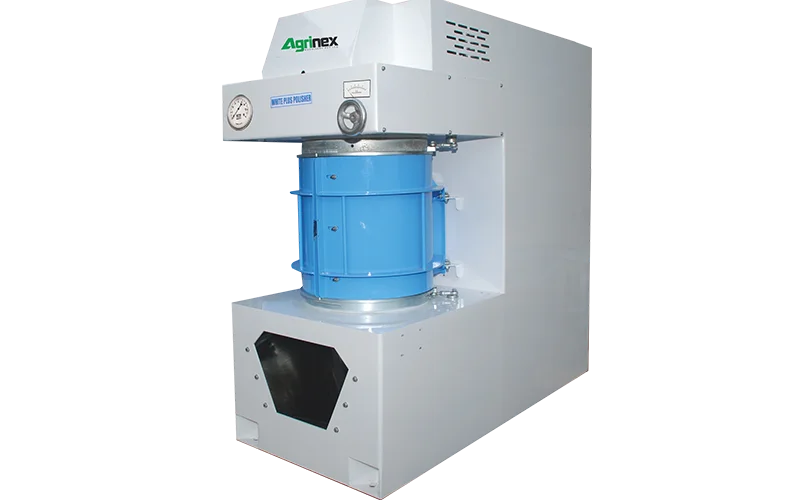
The Super Silky Polisher operates on a fundamentally different principle: water mist and light friction. After whitening, the grain surface still has microscopic bran dust and micro-roughness from the abrasion process. The polisher uses a fine water mist sprayed into the polishing chamber to moisten the grain surface slightly, then a softer friction mechanism buffs this surface layer to a smooth, translucent finish.
Polishing does not remove significant material from the grain — it refines the surface of what whitening has already created. The output of a properly run polisher is a grain with a glass-like sheen, bright translucency, and a surface that resists moisture absorption more effectively than unpolished white rice.
This visual quality is what premium buyers — retail chains, exporters, hotel suppliers — pay a premium for. Polished rice simply looks better in the bag, on the shelf, and on the plate.
| Feature | Rice Whitener | Super Silky Polisher |
|---|---|---|
| Primary Action | Abrasion bran removal | Water mist surface buffing |
| Input | Brown rice (post-shelling) | White rice (post-whitening) |
| Output | White-bodied grain | Shiny, translucent-finish grain |
| Material Removed | Bran layer (significant removal) | Micro-bran dust (minimal) |
| Degree of Change | Structural — changes grain composition | Aesthetic — refines surface finish |
| Water Used | None | Fine mist (precisely controlled) |
| Effect on Shelf Life | Extends (bran oil removed) | Further extends (surface sealed) |
| Market Impact | Enables white rice sale | Commands premium price segment |
| Use in Export Mills | Essential / mandatory | Strongly recommended |
When You Need Just a Whitener
A whitener alone is sufficient when your target market is domestic commodity buyers who purchase rice on a price-per-quintal basis with no specific surface finish requirement. This includes ration supply contracts, institutional bulk buyers, and lower-segment retail.
If your buyers do not discriminate between shiny and dull white rice — and your price per kg reflects this — a whitener covers the essential bran removal function. However, even in commodity markets, a well-calibrated whitener dramatically improves storage life by fully removing the bran oil layer that turns rice rancid over time.
When You Need Just a Polisher
Running a polisher without a whitener is rare and generally inadvisable. The polisher is designed to refine the output of the whitener — it cannot perform full bran removal on its own. Mills that attempt to use a polisher as a substitute for a whitener end up with a grain that has a surface sheen but residual bran underneath, leading to premature yellowing and storage failures.
The only scenario where a polisher alone makes sense is if you are sourcing pre-whitened rice from another mill and adding a final polishing pass before retail packaging under your own brand.
Why Top-Grade Mills Use Both in Sequence (And Why It Doubles Your Sale Price)
In any premium rice mill — one supplying to supermarkets, hotel chains, export buyers, or branded rice companies — both machines run in sequence, every batch, without exception. The logic is straightforward: the whitener does the structural work of bran removal to the correct DOM, and the polisher does the aesthetic work of surface refinement.
The market premium for fully polished, export-quality white rice over commodity white rice is typically ₹4–₹10 per kg depending on variety and buyer. For a mill processing 3,000 tonnes per year, this premium — earned by adding one additional machine to the finishing line — represents ₹1.2–₹3 crore in additional annual revenue.
Each machine is optimised for its specific function. Asking one to do the other’s job reduces quality at both stages. The investment in running both in sequence is not a luxury — it is an arithmetic decision.
Agrinex Rice Whitener + Super Silky Polisher: Built to Work as a Pair
Agrinex engineers the Rice Whitener and Super Silky Polisher to be matched in throughput, dimensional specifications, and quality output parameters. When purchased and installed together, the transfer between the two machines is seamless — the polisher’s feed rate and chamber dimensions are calibrated to receive exactly the output volume and grain condition that the whitener produces.
Both machines are manufactured using laser-precision fabrication at Power Tech Laser’s facility in Odisha, ensuring dimensional consistency that prevents the micro-vibration and grain stress that poorly matched machines introduce. The result is a finishing line that delivers consistent quality batch after batch, with predictable maintenance intervals and minimal downtime.
→ View full product specifications for the Agrinex Rice Whitener and Super Silky Polisher at Rice Whitener

