
Blog
- Home
- Uncategorized
- How a Modern Rice Milling Line Works: Step-by-Step Guide for Indian Rice Mill Owners
How a Modern Rice Milling Line Works: Step-by-Step Guide for Indian Rice Mill Owners
India produces more than 125 million tonnes of rice every year, making it the second-largest producer in the world. Yet a significant share of that potential revenue is lost not in the field, but on the milling floor. Inefficient machinery, skipped processing stages, and outdated equipment silently eat into recovery rates, grain quality, and export eligibility. For rice mill owners across Andhra Pradesh, Odisha, West Bengal, Punjab, and Tamil Nadu, understanding each stage of the milling line is not just technical knowledge — it is the foundation of a profitable operation.
This guide walks you through every step of a modern rice milling line, from raw paddy arrival to export-ready grain, and explains exactly which machine handles which job — and why cutting corners at any stage costs you money downstream.
Stage 1: Paddy Cleaning — Removing Dust & Impurities
Before a single grain of paddy enters the milling sequence, it must be thoroughly cleaned. Raw paddy arriving from farms contains dust, straw, husk pieces, and foreign particles accumulated during harvesting and transport. If these impurities enter downstream machines, the consequences are severe: increased roller wear, damaged screens, and degraded grain quality.
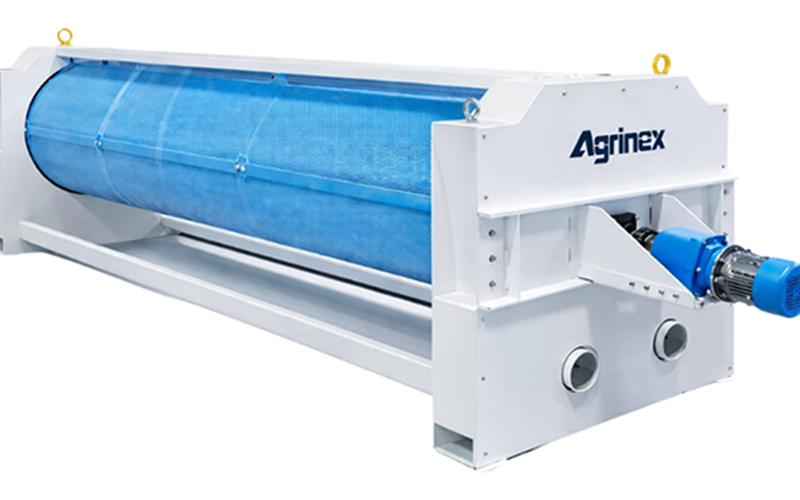
The Agrinex Paddy Cleaner is engineered to remove all coarse and fine impurities using a multi-layer vibrating screen system combined with powerful air aspiration. The result is clean, uniform paddy ready for the next stage. Mills that skip this step report significantly higher maintenance costs and more frequent roller replacements — costs that far outweigh the investment in a proper cleaning setup.
Key output: Dust-free, impurity-free paddy at consistent moisture levels.
Stage 2: De-Stoning — Why Stones Destroy Rollers
Even after cleaning, paddy batches often contain small stones of similar density to paddy grains — too heavy to be removed by aspiration alone. These stones, if left in the stream, cause catastrophic damage to the rubber rollers in the shelling stage. A single stone can permanently score a roller surface, reducing its lifespan from months to weeks.
The Agrinex Vibro De-Stoner uses a fluidised bed of air combined with a vibrating inclined deck to separate stones from paddy with high precision. Heavier stones migrate upward on the deck while lighter paddy grains move downward, resulting in a clean, stone-free stream entering the sheller.
Did You Know?
Mills running without a de-stoner replace rubber rollers up to 3× more frequently, adding substantial avoidable cost every season.
Key output: Stone-free paddy stream with protected rollers downstream.
Stage 3: Pneumatic Shelling — Husk Removal Without Grain Breakage
Shelling is the most mechanically intensive stage of the milling line — and also the stage where grain breakage most often occurs. Traditional friction-based shellers apply mechanical pressure to remove the husk, which frequently cracks the grain, directly reducing head rice recovery and market value.
The Agrinex Vibrosheller uses pneumatic principles to remove the husk through controlled air force and minimal mechanical contact. This approach dramatically reduces the percentage of broken grains exiting the sheller, preserving the whole-grain integrity that traders and exporters demand.
For mills supplying to premium buyers or export markets, the difference between friction-based and pneumatic shelling can translate to a price premium of ₹2–₹5 per kg on the finished product.
Key output: Dehusked brown rice with high whole-grain percentage.
Stage 4: Paddy Separation — Separating Unshelled Paddy
No sheller achieves 100% dehusking efficiency in a single pass. A portion of paddy exits the sheller with the husk still partially or fully intact. If this unshelled paddy enters the whitener directly, it damages whitening rollers and causes uneven milling.
The Agrinex Paddy Separator uses a combination of inclined oscillating surfaces and controlled air flow to distinguish between brown rice (lighter, smoother) and unshelled paddy (heavier, rougher). Unshelled paddy is returned to the sheller for a second pass, while brown rice proceeds to whitening.
This stage also ensures the sheller operates at its optimal efficiency point — mixed input leads to reduced throughput and increased mechanical stress.
Key output: 100% brown rice stream entering the whitening stage.
Stage 5: Whitening & Polishing — The Final Quality Step
Whitening and polishing are often misunderstood as a single process, but they are distinct stages that together define the final visual quality and market value of the rice.
Whitening, performed by the Agrinex Rice Whitener, removes the bran layer through controlled abrasion. The degree of milling (DOM) — how much bran is removed — determines the nutritional profile, colour, and shelf life of the grain. Under-milling leaves bran residue that causes yellowing. Over-milling removes too much endosperm, reducing yield.
Polishing, performed by the Agrinex Super Silky Polisher, uses a fine water mist and light friction to give the rice grain its final sheen. Polished rice has a brighter, more translucent appearance that commands higher prices in retail and export markets. For premium parboiled and basmati varieties, this stage is non-negotiable.
Key output: White, polished rice grains with uniform appearance and optimal degree of milling.
Stage 6: Grading & Shifting — Export-Ready Grain
The final stage of the milling line separates rice by length and removes any remaining broken grains, chalk grains, or discoloured particles. This is what separates commodity rice from premium, export-grade rice.
The Agrinex Length Grader uses precision-engineered cylindrical indented drums to separate whole grains from broken rice (‘brokens’). Brokens are typically sold at lower prices for flour or animal feed, while the whole-grain fraction commands a premium.
The Agrinex Rice Shifter (vibrating sifter) performs a final sorting pass, removing any remaining fine particles and ensuring a clean, uniform product ready for packaging and dispatch.
Key output: Graded, sorted rice meeting FSSAI, APEDA, and export quality standards.
How Agrinex Integrates All 8 Stages Into One Seamless Line
What distinguishes a high-performance rice mill from an average one is not individual machines — it is how seamlessly they work together. Agrinex designs its complete rice milling line as an integrated system, with each machine calibrated to match the throughput, output quality, and feed specifications of the next.
From the Paddy Cleaner at intake to the Length Grader at dispatch, every Agrinex machine is engineered to the same dimensional tolerances, built from high-grade fabricated steel, and manufactured using laser precision processes at Power Tech Laser’s facility in Odisha. The result is a milling line that operates with minimal downtime, consistent recovery rates, and predictable maintenance cycles.
Whether you are setting up a new mill or upgrading an existing one, Agrinex’s engineering team can design a line matched to your specific paddy variety, target output quality, and processing capacity — from 1 TPH to 10 TPH and beyond.
8 Stages of Rice Milling at a Glance
| Stage | Machine | Function | Output Quality Impact |
|---|---|---|---|
| 1. Paddy Cleaning | Agrinex Paddy Cleaner | Removes dust, straw & light impurities | Protects downstream rollers; uniform feed |
| 2. De-Stoning | Agrinex Vibro De-Stoner | Removes stones by density separation | Prevents roller damage; extends machine life |
| 3. Pneumatic Shelling | Agrinex Vibrosheller | Removes husk with minimal grain breakage | High whole-grain recovery; fewer brokens |
| 4. Paddy Separation | Agrinex Paddy Separator | Returns unshelled paddy for re-pass | 100% brown rice input to whitener |
| 5. Rice Whitening | Agrinex Rice Whitener | Abrasion-based bran removal to correct DOM | Controlled DOM; uniform whiteness |
| 6. Polishing | Agrinex Super Silky Polisher | Water mist polishing for grain sheen | Premium visual quality; higher sale price |
| 7. Grading | Agrinex Length Grader | Separates whole grain from brokens | Export-grade whole grain separation |
| 8. Shifting / Sifting | Agrinex Rice Shifter | Final sort; removes fines & particles | Clean, uniform finished product |
How Agrinex Integrates All 8 Stages Into One Seamless Line
What distinguishes a high-performance rice mill from an average one is not individual machines — it is how seamlessly they work together. Agrinex designs its complete rice milling line as an integrated system, with each machine calibrated to match the throughput, output quality, and feed specifications of the next.
From the Paddy Cleaner at intake to the Length Grader at dispatch, every Agrinex machine is engineered to the same dimensional tolerances, built from high-grade fabricated steel, and manufactured using laser precision processes at Power Tech Laser’s facility in Odisha. The result is a milling line that operates with minimal downtime, consistent recovery rates, and predictable maintenance cycles.
Whether you are setting up a new mill or upgrading an existing one, Agrinex’s engineering team can design a line matched to your specific paddy variety, target output quality, and processing capacity — from 1 TPH to 10 TPH and beyond.
